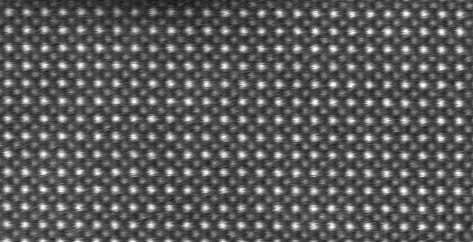
Absorption band
A range of wavelengths characteristic of a quantum transition in a substance.

Unknown author · Public domain
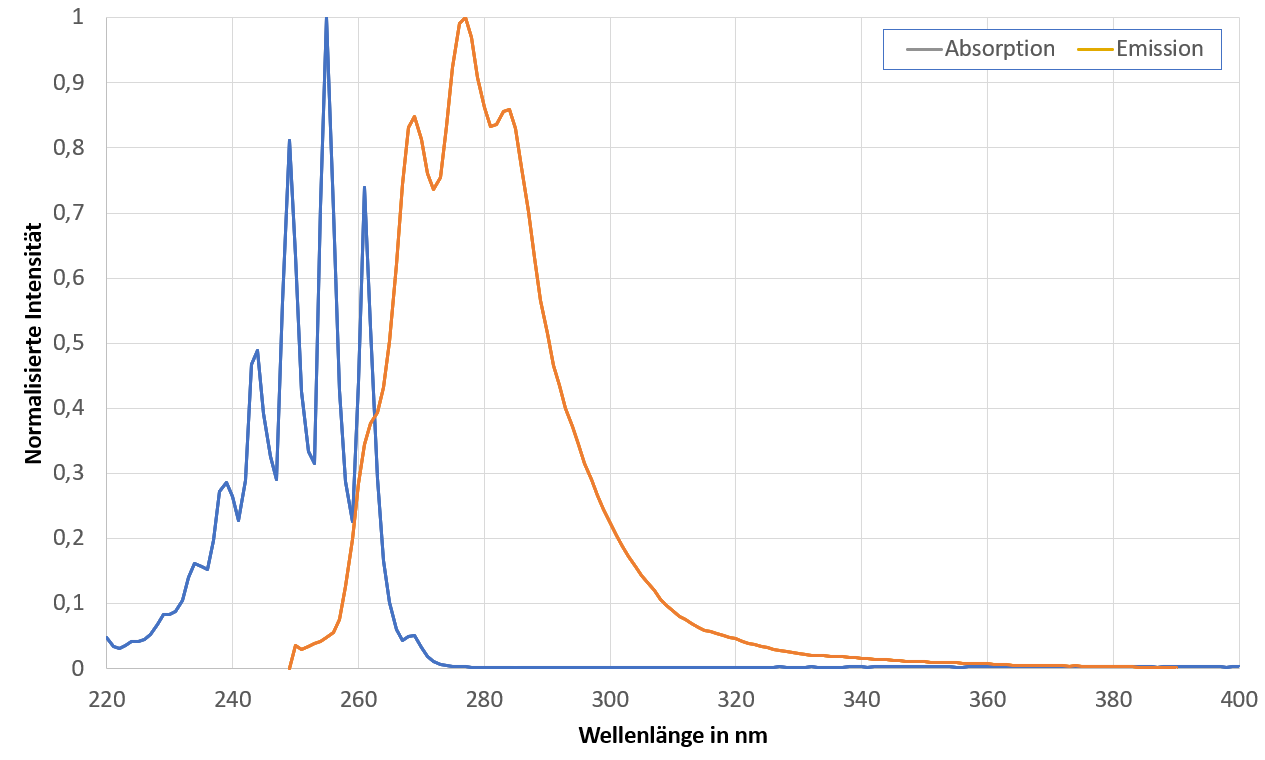
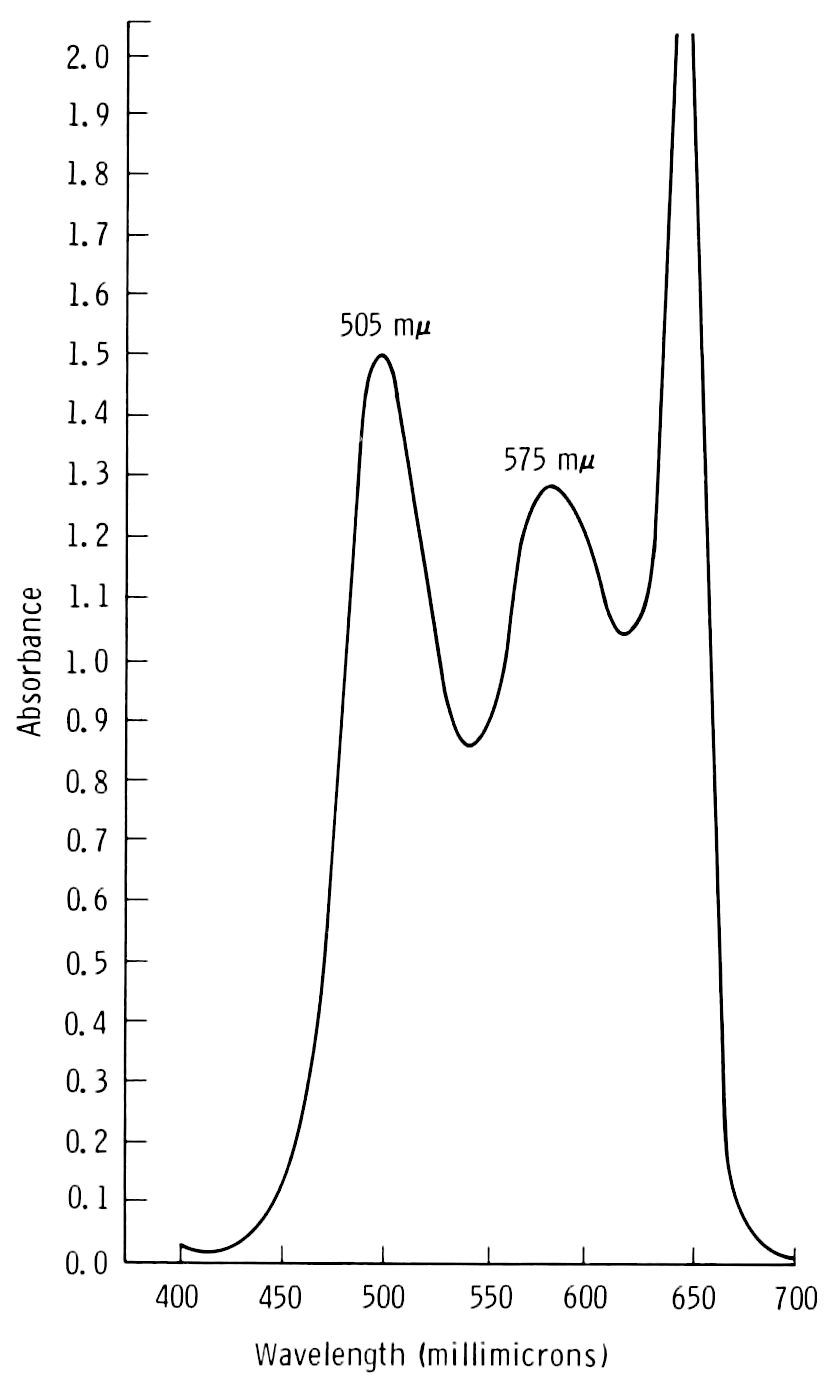
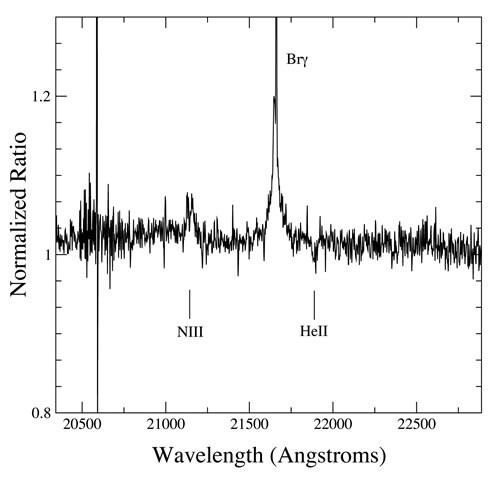
An absorption band is a range of wavelengths, frequencies, or energies in the electromagnetic spectrum that are characteristic of a particular transition from an initial to a final state in a substance. According to quantum mechanics, atoms and molecules can only hold certain defined quantities of energy, and when electromagnetic radiation is absorbed, the energy of the radiation changes the state of the atom or molecule from an initial state to a final state.
- field
- Spectroscopy
- key_concept
- Range of wavelengths characteristic of a transition from initial to final state
- related_phenomena
- Electronic, vibrational, rotational transitions; band and line shapes
- applications
- Pigments, dyes, optical filters, UV absorbers in sunscreen, atmospheric physics, radio communication
Lore & Background
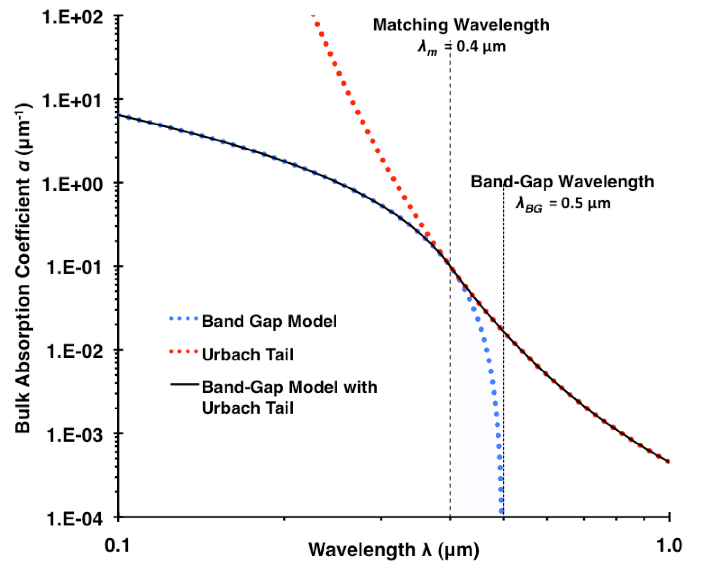
In spectroscopy, an absorption band arises when electromagnetic radiation is absorbed by an atom or molecule, changing its state from an initial to a final state. The number of states in a specific energy range is discrete for gaseous or diluted systems, while condensed systems like liquids or solids have continuous density of states distributions. The absorption process can move a particle like an electron from an occupied to an unoccupied state, or move a vibrating or rotating system from one state to another, or create a quasiparticle like a phonon or plasmon in a solid.
Reader's Guide
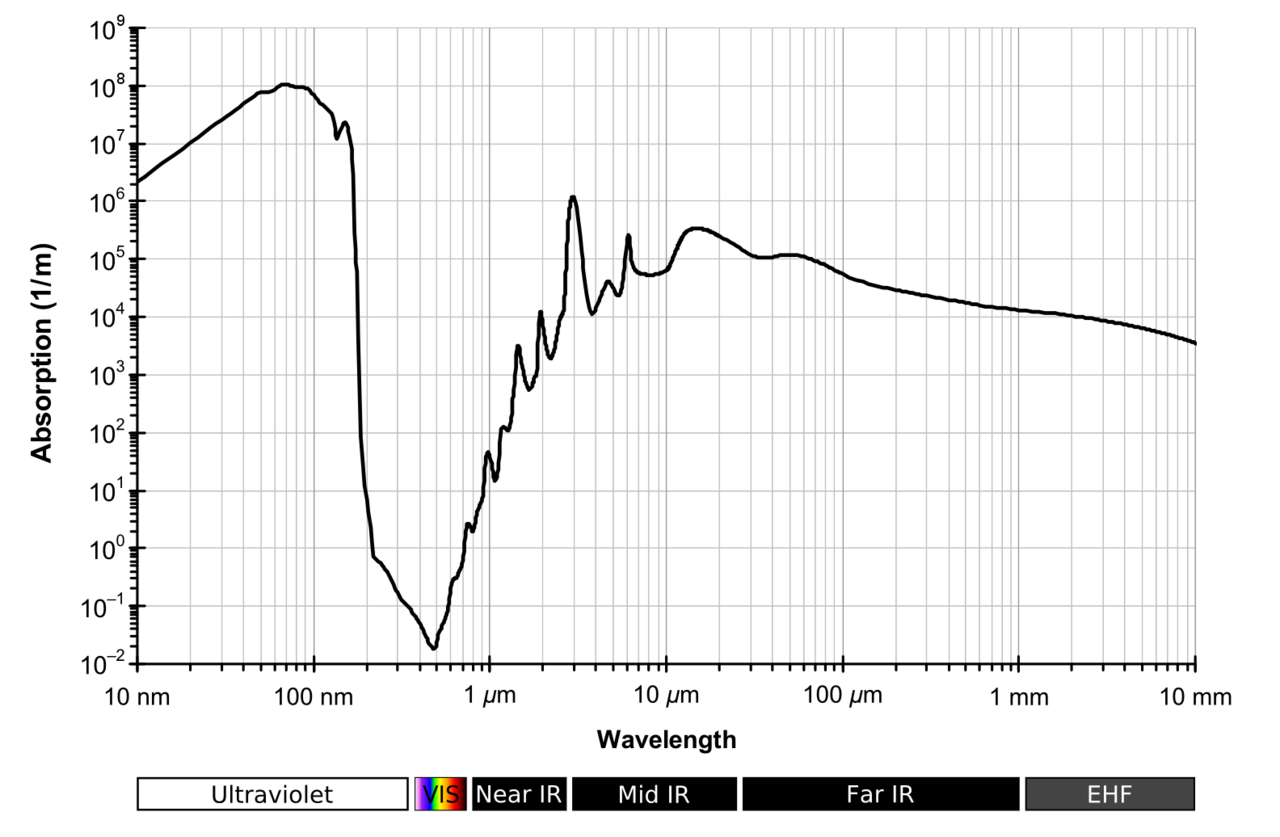
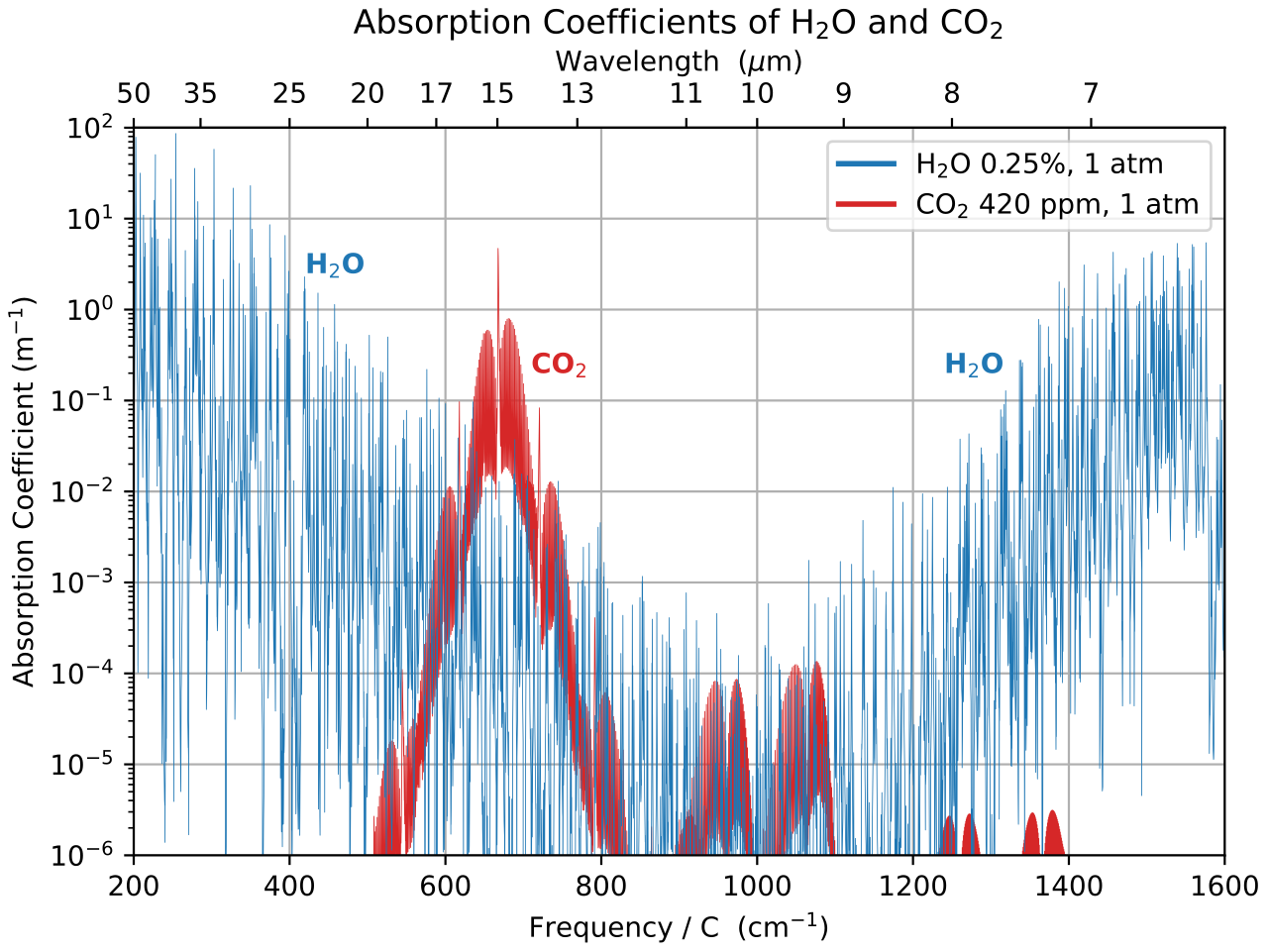
Absorption bands are fundamental to understanding how matter interacts with electromagnetic radiation across the spectrum. They are characterized by selection rules that constrain possible transitions, with strength determined by factors such as electric versus magnetic dipole moments and transition matrix elements. Temperature and statistical mechanics influence band intensity in infrared, microwave, and radio frequency ranges, while thermal motion effects like Doppler broadening affect linewidth. The analysis of band and line shapes—often assumed to be Lorentzian or Gaussian—can yield information about the system, such as in Mössbauer spectra. In condensed matter, band shapes are determined by transitions between states in continuous density of states distributions, with electronic band structure playing a key role in crystals. Absorption bands have practical applications in pigments, dyes, optical filters, and UV absorbers in sunscreen, and are of particular interest to atmospheric physicists for oxygen, ozone, and nitrogen bands, as well as to radio technicians for water vapor and oxygen absorption peaks.
Did You Know?
- Absorption bands in the radio frequency range are found in NMR spectroscopy, with frequencies and intensities determined by the magnetic moment of nuclei, applied magnetic field, and temperature occupation number differe
- Water vapor has a resonance peak at 22.24 GHz (1.35 cm) in the radio band.
Scope and Structure of Physical Crystallography
Before the discovery of X-rays in 1895, the study of crystals was organized into three major branches: geometrical, chemical, and physical crystallography. While the geometrical branch reached its climax with the identification of the 230 space groups between 1891 and 1894, physical crystallography took a different path. Rather than following a single narrative thread, it accumulated as a patchwork of discoveries across many distinct domains. Researchers examined how crystals interacted with light—double refraction, rotary polarization, conical refraction, absorption and pleochroism, luminescence, and infrared behavior. They probed electrical conduction, magnetic response, and dielectric behavior. They measured thermal expansion, heat conduction, thermoelectric effects, and pyroelectricity. They tested mechanical elasticity, photoelasticity, and piezoelectricity. Notably, the pre-X-ray era leaned heavily toward geometry and mathematical description rather than direct physical measurement, making the physical branch a scattered but rich collection of independent investigations rather than a unified discipline.
Symmetry as a Unifying Framework
Throughout the nineteenth century, the adoption of symmetry concepts fundamentally reshaped crystallography from a descriptive art into a rigorous mathematical science. The turning point came in 1832 when Franz Ernst Neumann applied symmetry reasoning to the problem of double refraction. His student Woldemar Voigt later formalized this insight in 1885 into what is now known as the Neumann principle: if a crystal remains unchanged under a particular symmetry operation, then every one of its physical properties must likewise remain unchanged under that same operation. This idea was later extended by Bernhard Minnigerode and Pierre Curie, whose broader formulation—that the symmetries present in the causes must appear in the effects—became a foundational rule in physics. By the close of the century, Voigt had gone further still, introducing tensor calculus as the mathematical language for describing how anisotropic crystals respond to external stimuli. This framework gave researchers a systematic way to predict which physical properties a given crystal symmetry could or could not exhibit, transforming scattered observations into a coherent theoretical structure.
Double Refraction and the Birth of Crystal Optics
The phenomenon of double refraction—where a single beam of light entering a birefringent crystal splits into two rays following slightly different paths—was first documented in 1669 by Rasmus Bartholin while examining calcite, also known as Iceland spar. Christiaan Huygens took up the challenge in 1690, proposing in his treatise on light that the characteristic rhomboidal shape of calcite arose from the stacking of tiny spherical particles, and that the unusual light behavior stemmed from the crystal's internal asymmetry. The early nineteenth century saw rapid advances: Malus identified polarization in 1810, Biot distinguished optically positive from negative crystals in 1812, and Brewster classified all crystals into isotropic, uniaxial, or biaxial categories in 1819. The field reached its theoretical maturity in 1827 when Fresnel described double refraction using the wave model of light with transverse polarization. Comprehensive syntheses followed in the 1890s and early 1900s from Fletcher, Liebisch, and Pockels, cementing crystal optics as a mature discipline.
Rotary Polarization and the Discovery of Molecular Chirality
The rotation of polarized light as it passes through certain crystals opened a window into the hidden asymmetry of matter. François Arago first observed this effect in quartz in 1811, and the following year Biot established that the rotation was proportional to both the thickness of the material and the wavelength of the light, noting that some crystals rotated the beam rightward while others rotated it leftward. John Herschel, in 1821, made the crucial link between the direction of rotation and the arrangement of crystal faces, recognizing that quartz crystals could exist as mirror-image pairs. Fresnel provided a wave-based explanation in 1822 by proposing that oppositely circularly polarized components traveled at different speeds along the optic axis. The most transformative contribution came from Louis Pasteur in 1848, who physically separated the right- and left-handed crystals of a racemic tartrate salt and showed that their solutions rotated polarized light in opposite directions—revealing molecular chirality for the first time. By 1855, Marbach had identified additional salts sharing this remarkable property.
Gallery
Frequently Asked Questions
What exactly is an absorption band in crystallography?
An absorption band is a specific stretch of wavelengths (or equivalently frequencies or energies) in the electromagnetic spectrum where a material soaks up radiation. It marks the energy gap between a well-defined initial quantum state and a well-defined final state of the atoms or molecules in that substance.
Why do absorption bands appear as broad ranges rather than single sharp lines?
Because real crystals and molecules have many closely spaced energy levels arising from vibrational and rotational sub-states stacked on top of the primary electronic transition. The overlap of all those nearby transitions smears the signal into a band rather than a single spectral line.
What quantum rule makes absorption bands possible?
Quantum mechanics restricts atoms and molecules to discrete energy levels, so they can only absorb photons whose energy exactly matches the gap between an occupied lower state and an allowed upper state. When that condition is met, the radiation is taken up and the particle jumps to the higher-energy configuration.
Which kinds of transitions give rise to absorption bands?
The three main families are electronic transitions (electrons moving between orbitals), vibrational transitions (bonds stretching and bending), and rotational transitions (molecules changing their spin state). In a crystal, all three can contribute to the overall band shape observed in a spectrum.
Where do absorption bands show up in everyday technology?
They are the principle behind pigments and dyes that give color, UV-absorbing filters in sunscreen, and optical filters in telecommunications. In atmospheric science, identifying absorption bands of gases like CO₂ or ozone lets researchers track composition and climate effects.
More in Crystallography 1-20
Spotted an error? Know more?
This is a living reference — every entry is fact-audited, and reader corrections feed straight into our audit queue. Suggest an edit · See this site's audit record