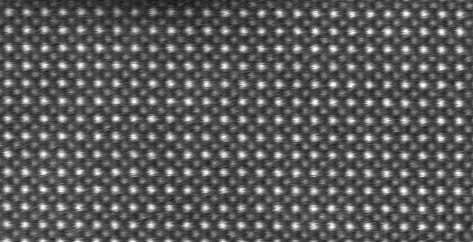
Brillouin zone
A primitive cell in reciprocal space for periodic media.

Inductiveload · Public domain
The Brillouin zone is a uniquely defined primitive cell in reciprocal space, named after the French physicist Léon Brillouin. It is fundamental to the description of waves in periodic media, as Bloch's theorem shows that solutions can be completely characterized by their behavior within a single Brillouin zone.
- field
- Mathematics and solid state physics
- known_for
- First Brillouin zone
- nationality
- French
Lore & Background
The first Brillouin zone is the locus of points in reciprocal space closer to the origin than to any other reciprocal lattice point, equivalently the Voronoi cell around the origin. Its boundaries are given by planes related to points on the reciprocal lattice, analogous to how the Bravais lattice is divided into Wigner–Seitz cells in real space. Higher-order Brillouin zones exist, consisting of points reached by crossing exactly n−1 distinct Bragg planes, but the first zone is most commonly used.
Reader's Guide
The Brillouin zone is central to solid state physics because it provides the natural domain for describing electron wavefunctions in crystals via Bloch's theorem. Within the zone, constant-energy surfaces (such as the Fermi surface) represent all k-points with the same energy, separating filled from unfilled orbitals at zero Kelvin. The concept was developed by Léon Brillouin, and the irreducible Brillouin zone further reduces the first zone by the symmetries of the crystal's point group. Critical points of high symmetry within the zone are of special interest for understanding electronic properties.
Did You Know?
- The first Brillouin zone is the set of points in k-space that can be reached from the origin without crossing any Bragg plane.
- Higher-order Brillouin zones are disjoint regions at increasing distances from the origin, all with the same volume.
- The irreducible Brillouin zone is the first Brillouin zone reduced by all symmetries in the point group of the lattice.
Geometric Definition and Construction
The first Brillouin zone occupies a uniquely defined position in reciprocal space, serving as a primitive cell that partitions the reciprocal lattice in much the same way Wigner–Seitz cells partition the real-space Bravais lattice. Its boundaries are formed by planes associated with reciprocal lattice points, and it can be characterized in several equivalent ways. One definition identifies it as the collection of all points in reciprocal space that lie closer to the origin than to any other reciprocal lattice point, mirroring the construction of a Wigner–Seitz cell. Another describes it as the set of wave-vector points reachable from the origin without crossing any Bragg plane. Yet another frames it as the Voronoi cell centered on the origin of the reciprocal lattice. Because of this precise geometric definition, the first zone is so central to the field that it is frequently referred to simply as the Brillouin zone, even though higher-order zones also exist.
Physical Significance and the Fermi Surface
The practical importance of the Brillouin zone arises from Bloch's theorem, which governs how waves propagate through a periodic medium. According to this theorem, the complete set of solutions for wave behavior in a crystal can be fully characterized by examining their properties within a single Brillouin zone alone. Within that zone, surfaces of constant energy trace out all the wave-vector points corresponding to a single energy value, effectively mapping every possible electron momentum at that energy. A particularly important special case is the Fermi surface, which is the constant-energy surface that, at absolute zero temperature, separates filled electronic orbitals from unfilled ones. This surface plays a central role in determining the electrical and thermal properties of metals and semiconductors, making the Brillouin zone the natural arena in which electronic band structure is analyzed and understood.
Higher-Order Zones and the Irreducible Zone
Beyond the first zone, a sequence of second, third, and higher Brillouin zones extends outward in reciprocal space. Each of these zones is a disjoint region of equal volume situated at progressively greater distances from the origin. The n-th Brillouin zone is formally defined as the collection of points reachable from the origin by crossing exactly n minus one distinct Bragg planes. Despite their mathematical existence, these higher zones see considerably less use in practice, which is why the first zone has become the default reference. A closely related and highly useful concept is the irreducible Brillouin zone. This is obtained by taking the first zone and factoring out all the symmetries belonging to the point group of the crystal lattice. The result is a smaller fundamental region that captures all physically distinct information, dramatically reducing the computational and analytical workload needed to study the electronic or vibrational properties of a given crystal.
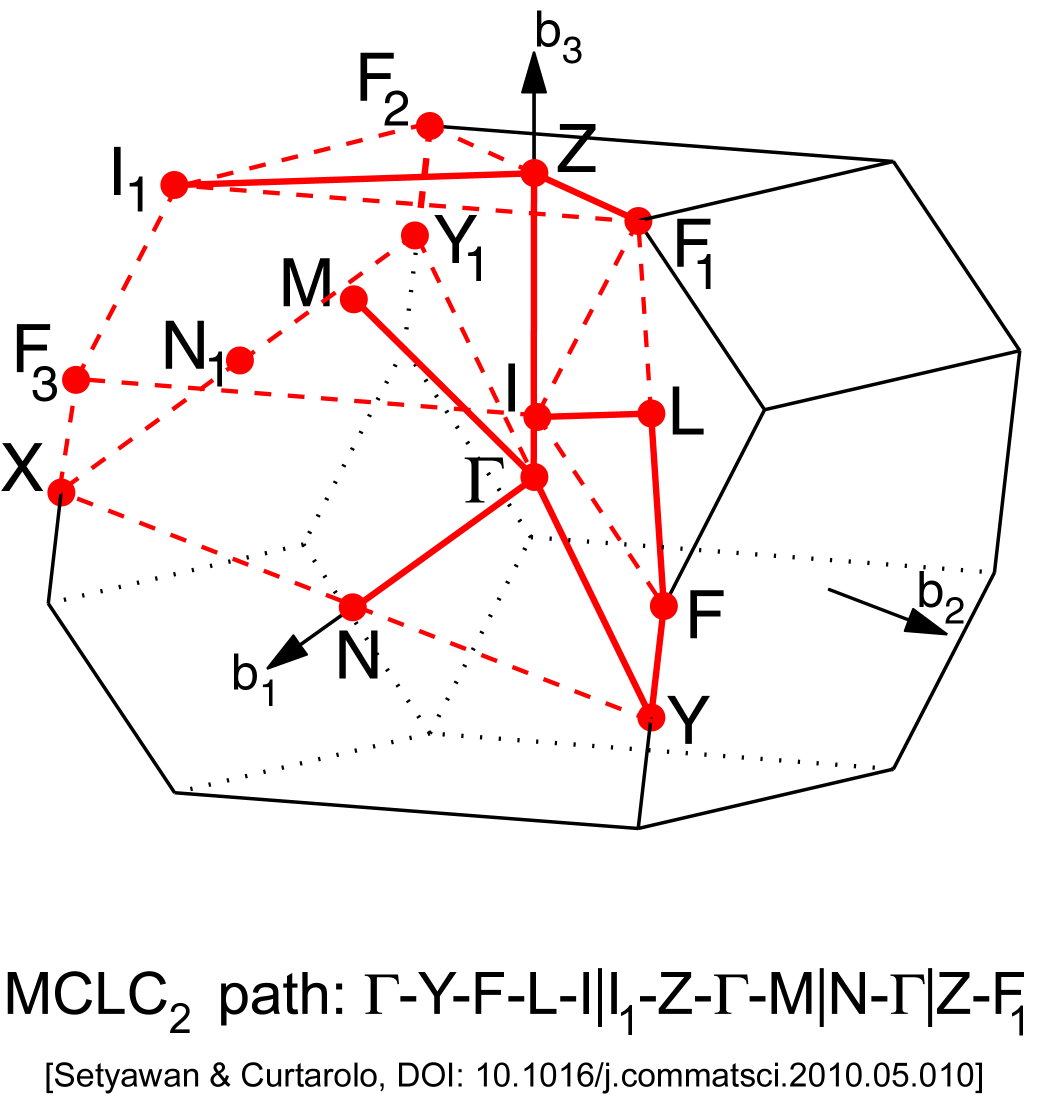
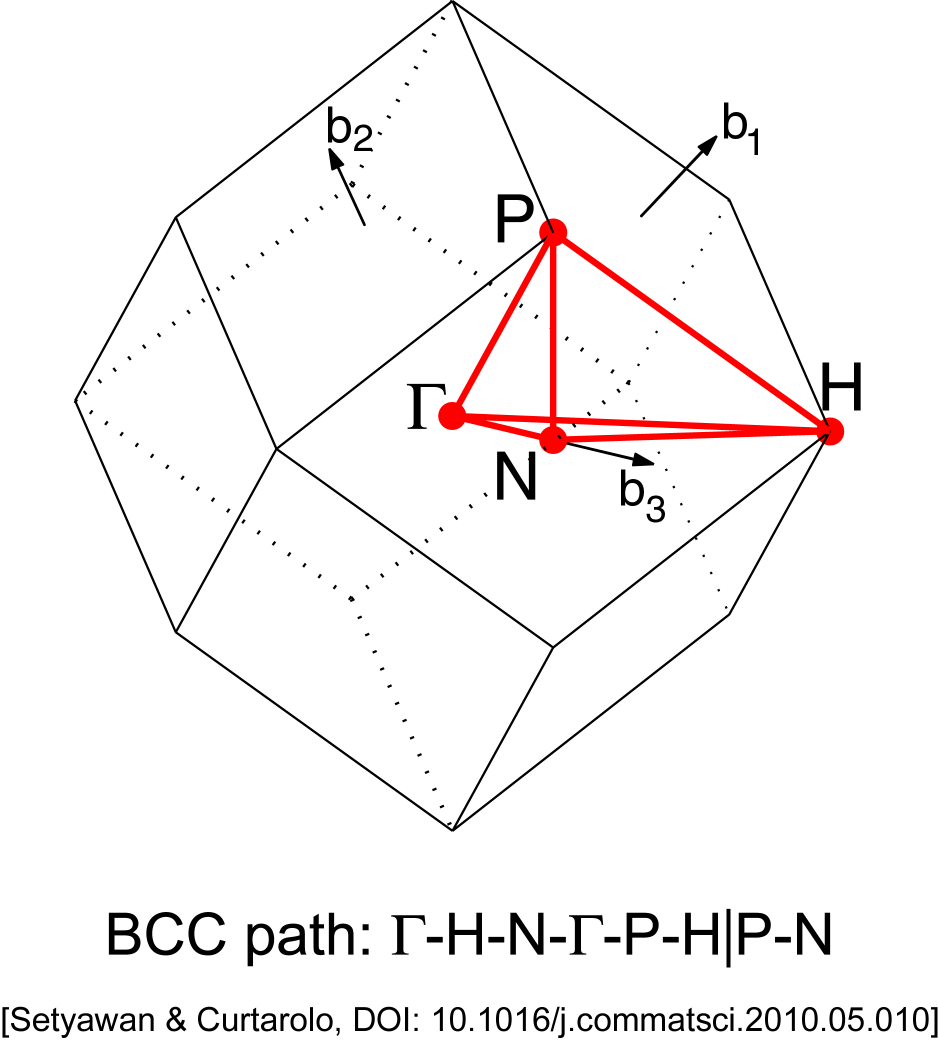
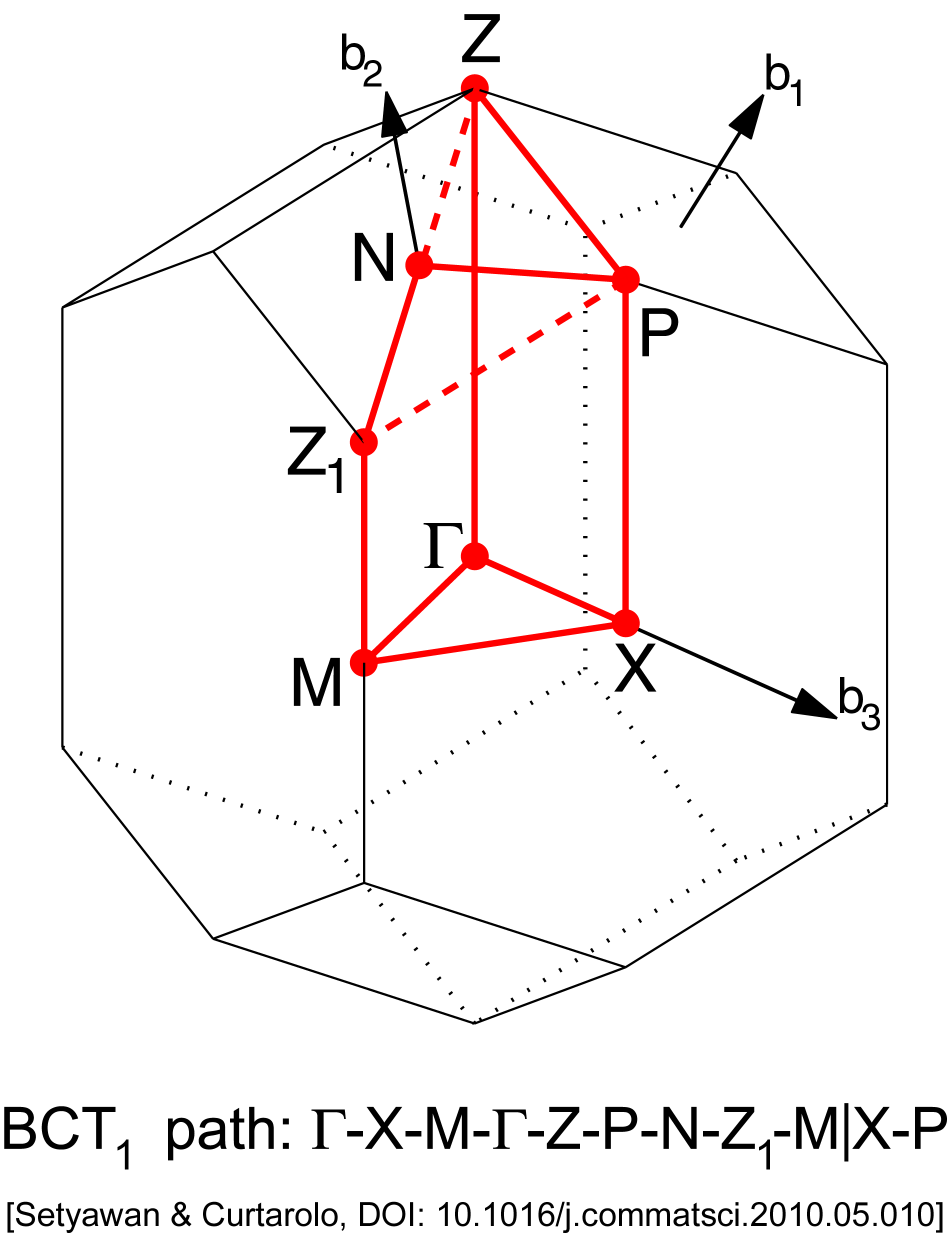
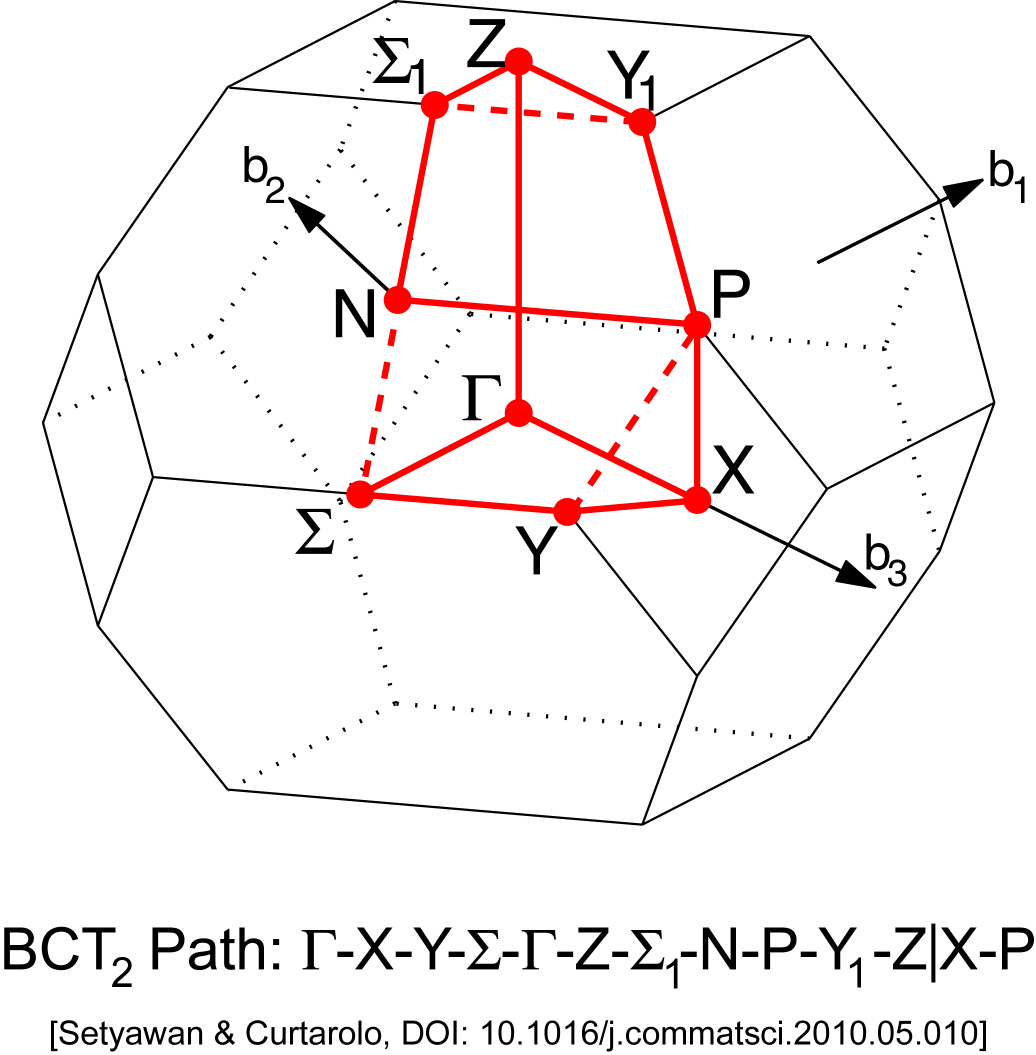
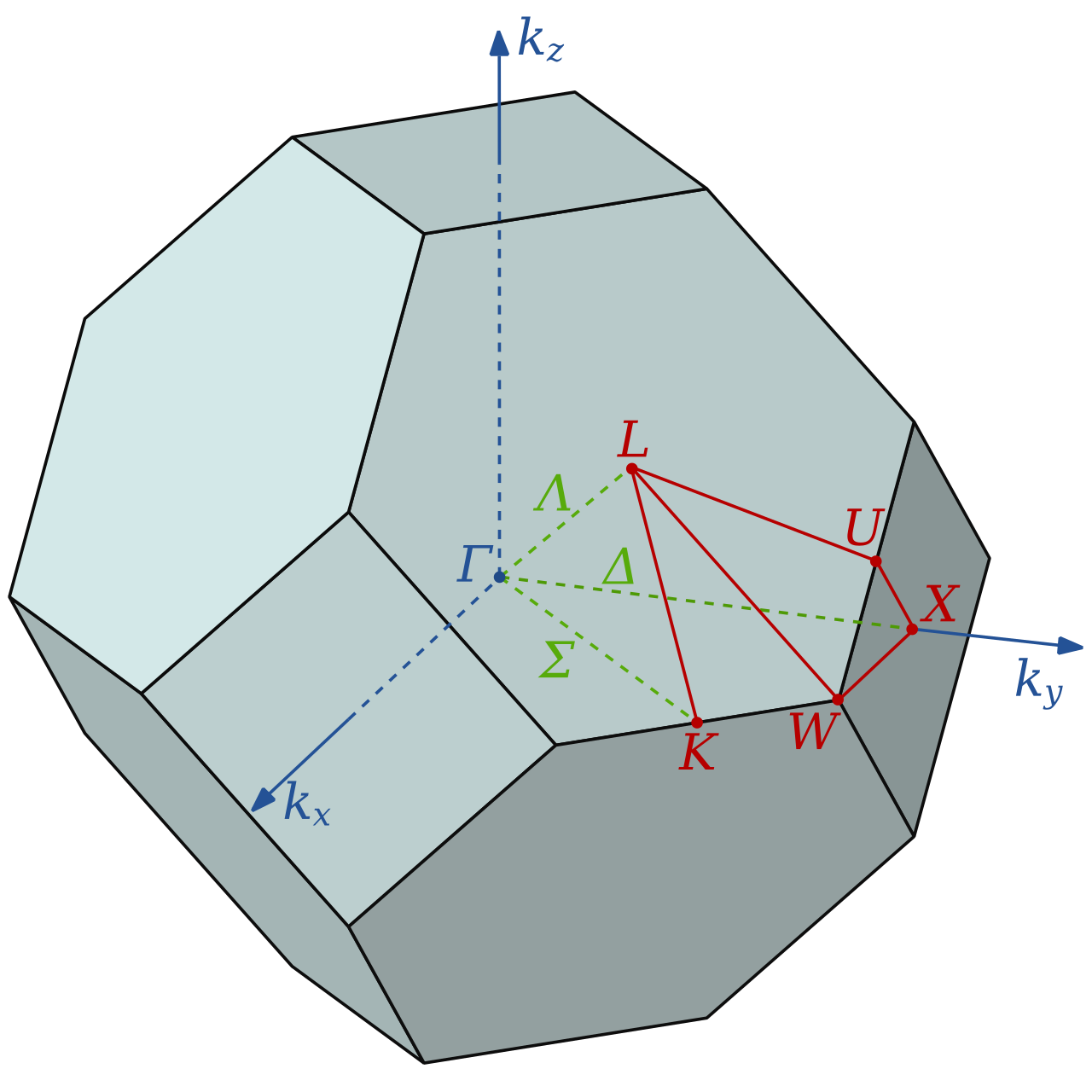
Lattice-Specific Geometry and Critical Points
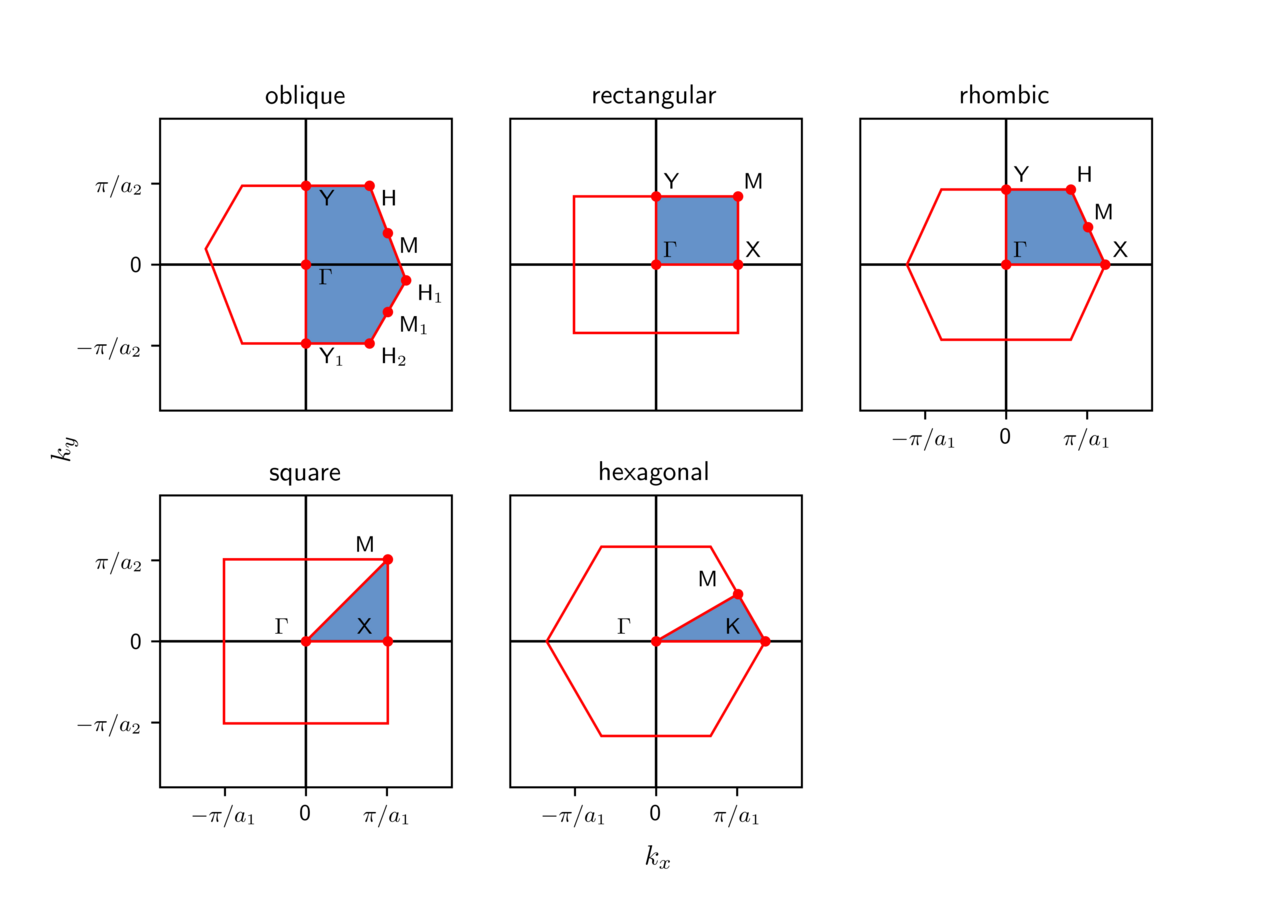
The actual shape of a Brillouin zone depends entirely on the underlying Bravais lattice. In three dimensions, the fourteen distinct Bravais lattices each produce a characteristic zone geometry, while in two dimensions the situation simplifies to just five Bravais lattices, each yielding its own distinctive zone boundary. Within every zone, certain high-symmetry points—known as critical points—carry special physical significance and are of particular interest for calculations involving electronic band structures or phonon dispersions. The specific locations and types of these critical points vary from one lattice to another. In two-dimensional illustrations, the zone boundaries are typically delineated by red lines, and the irreducible portion is highlighted in blue, reflecting the symmetry points defined by the lattice's point group. This geometric diversity means that understanding the Brillouin zone of a particular material requires careful attention to its specific crystallographic structure.
Gallery
Frequently Asked Questions
Who is Brillouin zone?
Brillouin zone is a uniquely defined primitive cell in reciprocal space, named after the French physicist Léon Brillouin. It sits at the crossroads of mathematics and solid-state physics.
What is Brillouin zone's role in the story?
It acts as the fundamental stage on which all wave behavior in a periodic medium is described. Bloch's theorem guarantees that every solution can be fully captured by examining just one Brillouin zone.
What is Brillouin zone known for?
Its most iconic appearance is the First Brillouin zone, the smallest and most frequently referenced version of the concept in textbooks and research.
Why is Brillouin zone important to the canon?
Without it, the infinite repetition of a crystal lattice would be impossible to reduce to a single manageable region for analysis. It is the structural key that makes Bloch's theorem work.
What nationality does Brillouin zone carry?
It has French origins, having been named in honor of Léon Brillouin, a French physicist who contributed to the field.
More in Crystallography 1-20
Spotted an error? Know more?
This is a living reference — every entry is fact-audited, and reader corrections feed straight into our audit queue. Suggest an edit · See this site's audit record