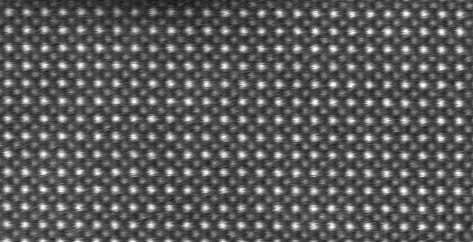
Atomic packing factor
Fraction of volume in a crystal occupied by atoms.

Atomic packing factor (APF), also known as packing efficiency or packing fraction, is a dimensionless quantity in crystallography that represents the fraction of volume in a crystal structure occupied by constituent particles. It is always less than unity and is determined by assuming atoms are rigid spheres with radii set to the maximum value such that atoms do not overlap. The APF is relevant to materials science, as it helps explain certain material properties, but it does not directly determine workability. For instance, HCP metals have a high APF (0.74) but are often brittle, while BCC metals with a lower APF (0.68) can be highly ductile, showing that workability depends on other factors like slip systems and bonding.
- field
- Crystallography, Materials Science
- known_for
- Quantifying the fraction of volume occupied by atoms in a crystal structure
- key_values
- HCP: 0.74, FCC: 0.74, BCC: 0.68, Simple cubic: 0.52, Diamond cubic: 0.34
Lore & Background
In crystallography, atomic packing factor (APF) is defined as the fraction of volume in a crystal structure that is occupied by constituent particles. It is a dimensionless quantity and always less than unity. For one-component crystals, the APF is represented mathematically by APF = (N_particle * V_particle) / V_unit cell, where N_particle is the number of particles in the unit cell, V_particle is the volume of each particle, and V_unit cell is the volume occupied by the unit cell. It can be proven mathematically that for one-component structures, the most dense arrangement of atoms has an APF of about 0.74, obtained by the close-packed structures. For multiple-component structures, the APF can exceed 0.74.
Reader's Guide
The atomic packing factor is a fundamental concept in materials science, providing insight into the density and properties of crystalline materials. Common sphere packings taken on by atomic systems include hexagonal close-packed (HCP) and face-centered cubic (FCC), both with an APF of 0.74; body-centered cubic (BCC) with 0.68; simple cubic with 0.52; and diamond cubic with 0.34. The majority of metals take on either the HCP, FCC, or BCC structure. The APF is relevant to the study of materials science because it explains many properties of materials; for example, metals with a high atomic packing factor have higher workability, similar to how a road is smoother when stones are closer together, allowing metal atoms to slide past one another more easily.
Did You Know?
- The atomic packing factor is always less than unity.
- For one-component structures, the most dense arrangement of atoms has an APF of about 0.74, obtained by close-packed structures.
- For multiple-component structures, the APF can exceed 0.74.
Defining the Packing Fraction
The atomic packing factor, also referred to as packing efficiency or packing fraction, quantifies how much of a crystal's total volume is actually filled by its constituent particles. As a dimensionless ratio, it can never reach or exceed one, and by long-standing convention in atomic systems, each atom is modeled as a perfectly rigid sphere. The sphere's radius is set to the largest possible value that prevents any two neighboring atoms from overlapping. For crystals composed of a single type of particle, the calculation reduces to a straightforward division: multiply the number of particles residing in one unit cell by the volume of a single particle, then divide by the total volume of that unit cell. This elegant formula captures the essential geometry of how tightly matter is arranged at the atomic scale, providing a single number that summarizes the spatial efficiency of an entire crystal lattice.
The 0.74 Ceiling and Close-Packed Perfection
A remarkable result in mathematical geometry, the Kepler conjecture, establishes that no arrangement of identical spheres can fill space more efficiently than the close-packed structures, which achieve a packing fraction of approximately 0.74. Both the hexagonal close-packed and face-centered cubic lattices reach this theoretical maximum, making them the densest possible configurations for a single-component crystal. This ceiling is not merely an empirical observation but a proven mathematical limit, meaning that roughly 26 percent of the volume in even the tightest single-atom packing remains empty space. However, the story changes when multiple types of particles are involved. In interstitial alloys, where smaller atoms nestle into the gaps between larger ones, the overall packing fraction can surpass the 0.74 threshold, demonstrating that multi-component systems unlock spatial efficiencies unavailable to their single-element counterparts.
A Spectrum of Packing Efficiencies
Among single-component crystal structures, the packing fraction spans a wide range depending on how atoms are arranged within the unit cell. The hexagonal close-packed and face-centered cubic structures both achieve the maximum of 0.74, with the latter also known as cubic close-packed. The body-centered cubic lattice falls slightly below at 0.68, while the simple cubic arrangement drops to approximately 0.52. At the sparsest end sits the diamond cubic structure, where only about 34 percent of the volume is occupied by atoms. In the simple cubic case, just one atom occupies the unit cell, whose edge length equals twice the atomic radius, yielding a packing fraction of π/6. For the face-centered cubic cell, four atoms are present, and the body diagonal measures four radii, linking the lattice parameter to the atomic radius through a factor of 2√2. The vast majority of metallic elements adopt one of the three denser arrangements—HCP, FCC, or BCC—reflecting nature's preference for efficient atomic packing.
Why Packing Fraction Shapes Material Behavior
Beyond pure geometry, the atomic packing factor carries direct consequences for how materials behave in the real world. In materials science, the APF helps explain a wide range of physical properties, and one of the most intuitive connections involves mechanical workability. Metals that crystallize in high-packing structures, those with APF values near 0.74, tend to exhibit greater malleability and ductility. The reasoning is straightforward: when atoms are packed more tightly together, they can more readily slide past one another under applied stress, much like a road surface becomes smoother and more navigable when the stones are laid closer together. Conversely, structures with lower packing fractions leave more void space, making it harder for atomic planes to shift relative to each other. This single dimensionless number thus serves as a useful predictor of whether a metal will deform gracefully or resist deformation, linking abstract crystallographic geometry to the practical engineering of metals.
Frequently Asked Questions
What is Atomic packing factor?
Atomic packing factor is a dimensionless number in crystallography that tells you what fraction of a crystal's total volume is actually filled by its constituent atoms. It is calculated by treating each atom as a rigid sphere sized to the maximum radius that prevents any two atoms from overlapping.
What are Atomic packing factor's key values across crystal structures?
The APF differs depending on the lattice type: hexagonal close-packed and face-centered cubic both reach 0.74, body-centered cubic sits at 0.68, simple cubic drops to 0.52, and diamond cubic is the lowest at 0.34.
Why is Atomic packing factor important in materials science?
APF helps explain certain bulk material properties by quantifying how densely atoms are arranged within a unit cell. However, it does not directly predict workability, since HCP metals share the same 0.74 value as FCC yet often exhibit brittleness.
How is Atomic packing factor calculated?
You divide the total volume occupied by all atoms in a unit cell by the volume of that unit cell itself, assuming each atom is a hard sphere with the largest radius that keeps neighboring atoms from intersecting.
Is Atomic packing factor always less than 1?
Yes, by definition the APF is strictly below unity because atoms are modeled as non-overlapping spheres, which guarantees some interstitial void space remains between them in any crystal lattice.
More in Crystallography 1-20
Spotted an error? Know more?
This is a living reference — every entry is fact-audited, and reader corrections feed straight into our audit queue. Suggest an edit · See this site's audit record