
Coordination number
Number of atoms bonded to a central atom in a molecule or crystal.

Ronit.kumar.10485 · CC BY-SA 3.0
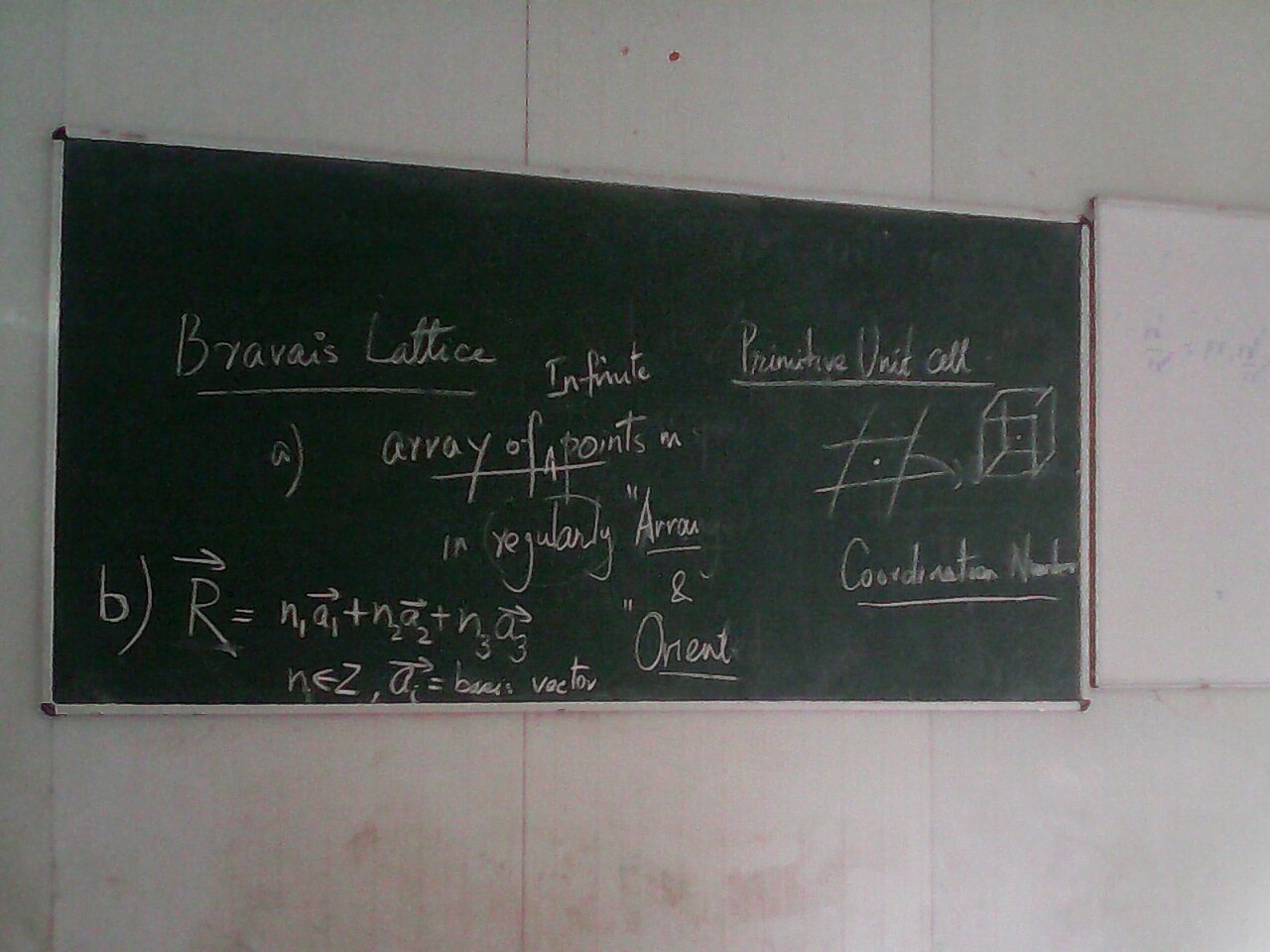
Coordination number, also called ligancy, is a concept in chemistry, crystallography, and materials science that describes the number of atoms, molecules, or ions bonded to a central atom in a molecule or crystal.
- field
- Chemistry, crystallography, materials science
- known_for
- Describing the number of neighbors bonded to a central atom in molecules and crystals
- common_coordination_numbers
- 4, 6, 8
- most_common_for_d-block
- 6
- range_for_transition_metals
- 2 to 9
- range_for_f-block
- 8 to 12
Lore & Background
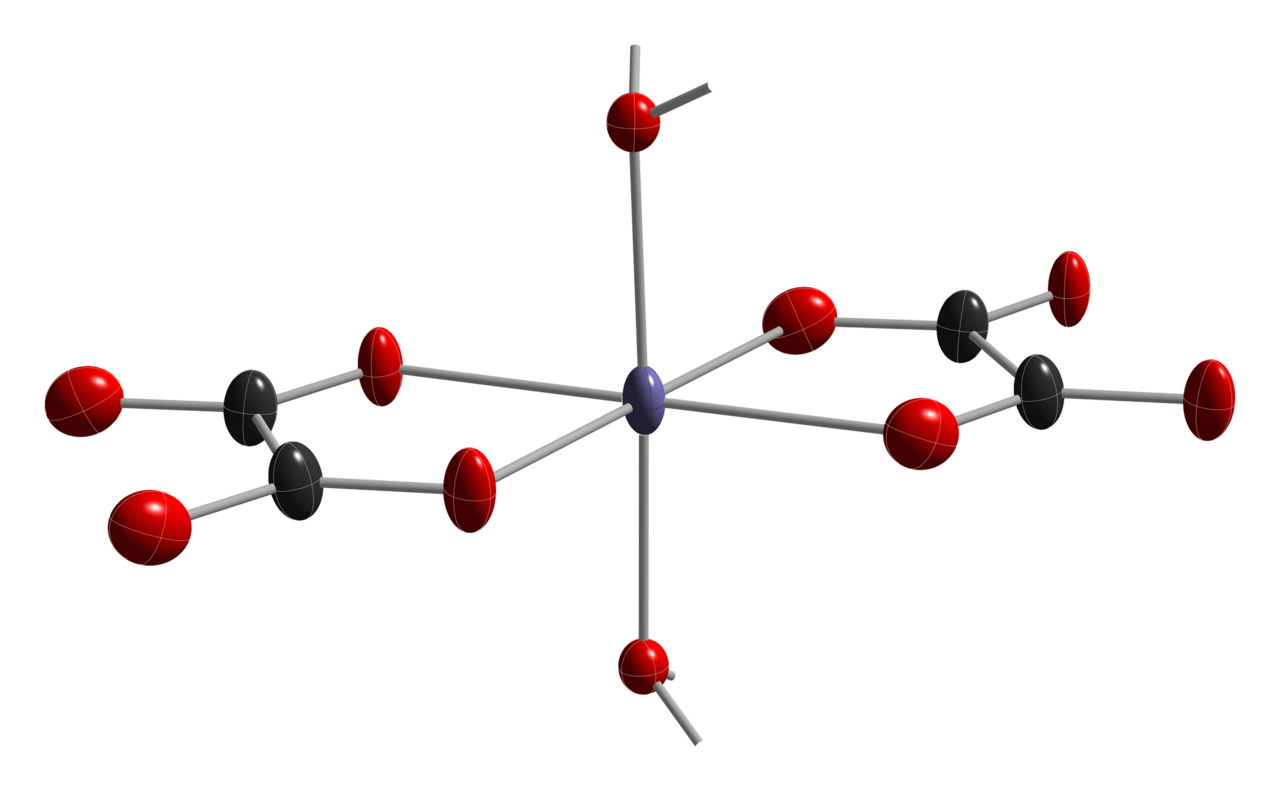
The coordination number is determined differently for molecules than for crystals. For molecules and polyatomic ions, it is found by counting the other atoms bonded to the central atom via single or multiple bonds. For example, [Cr(NH3)2Cl2Br2]− has Cr3+ as its central cation with a coordination number of 6, described as hexacoordinate. For d-block transition metal complexes, the most common coordination number is 6, though it does not distinguish geometry such as octahedral versus trigonal prismatic. Coordination numbers for transition metals range from 2 (e.g., AuI in Ph3PAuCl) to 9 (e.g., ReVII in [ReH9]2−). f-block elements can accommodate higher coordination numbers, from 8 to 12, due to greater ionic radii and more available orbitals; for instance, CeIV and ThIV form 12-coordinate ions [Ce(NO3)6]2− and [Th(NO3)6]2−.
Reader's Guide
The coordination number is a fundamental concept for understanding the structure of molecules and crystals. In crystalline solids, the bulk coordination number counts nearest neighbors in all directions, while surface coordination numbers are smaller and depend on the Miller indices of the surface. For example, in a body-centered cubic crystal, the bulk coordination number is 8, but for the (100) surface it is 4. The concept becomes ambiguous with polyhapto ligands, where hapticity (η) describes the number of adjacent atoms in a π-electron system binding to the central atom; in ferrocene, each cyclopentadienide anion has η=5, and the contribution to coordination number may be assigned as one, five, or three depending on convention. Complications arise when metal-ligand bonds are not all at the same distance, as in PbCl2, or when structures are irregular, such as zinc's distorted hexagonal close packing. The International Union of Crystallography notes that coordination number depends on the chemical bonding model and calculation method. Proposals exist for an effective coordination number (e.c.n. or ECoN) that weights surrounding atoms by distance.
Did You Know?
- The most common coordination number for d-block transition metal complexes is 6.
- An extremely rare coordination number of 1 occurs in the terphenyl-based arylthallium(I) complex 2,6-Tipp2C6H3Tl.
- In diamond, each carbon atom has a coordination number of 4; in graphite, each carbon has a coordination number of 3.
Origins and Fundamental Definition
The concept of coordination number traces back to 1893, when Alfred Werner introduced the idea of counting the total number of neighboring species around a central atom within a molecule or polyatomic ion. In this framework, every atom, molecule, or ion that bonds to the central species is designated a ligand, and the resulting count—also known as ligancy—becomes a fundamental descriptor of molecular architecture. For discrete molecules and polyatomic ions, the determination is straightforward: one simply tallies the bonded neighbors, whether connected through single bonds or multiple bonds. A classic illustration is the anionic complex [Cr(NH3)2Cl2Br2]−, in which the chromium(III) cation is surrounded by six ligands and is therefore described as hexacoordinate. Across the broader landscape of coordination chemistry, the numbers 4, 6, and 8 emerge as the most frequently encountered values. Although the definition applies to any central atom in a molecular or ionic context, the concept finds its most natural and widespread application in the study of coordination complexes, where the geometric arrangement of ligands around a metal center is of central interest.
The Spectrum of Coordination: From One to Sixteen
Transition metals in the d-block typically favor a coordination number of six, though the actual range spans from two—as seen in the gold(I) species within Ph3PAuCl—to nine, exemplified by the rhenium(VII) nonahydride anion [ReH9]2−. Moving to the f-block, the larger ionic radii of lanthanoid and actinoid elements, combined with the availability of additional bonding orbitals, permit coordination numbers between eight and twelve. Cerium(IV) and thorium(IV) both form twelve-coordinate anions with bidentate nitrate ligands, yielding [Ce(NO3)6]2− and [Th(NO3)6]2− respectively. At the upper extreme, computational studies have predicted a remarkably stable lead-helium cation, PbHe15+, in which a single lead ion is encircled by fifteen helium atoms, while metallic Frank–Kasper phases can exhibit coordination numbers reaching sixteen. At the opposite end, steric bulk can suppress coordination to extraordinary lows; a terphenyl-based arylthallium(I) complex, 2,6-Tipp2C6H3Tl, represents one of the rarest known instances of a metal center bonded to only a single ligand.
Crystal Lattices, Surfaces, and Experimental Methods
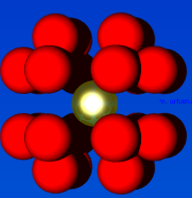
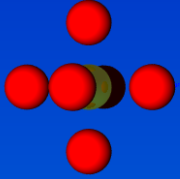
Within a crystal lattice, the bulk coordination number is well defined: one counts the nearest neighbors in every spatial direction. However, atoms residing at a surface lose neighbors on one side, so the surface coordination number is necessarily smaller and often variable, depending on the Miller indices of the exposed face. In a body-centered cubic crystal, the interior coordination number is eight, yet the (100) surface plane drops this to four. Experimental determination relies heavily on X-ray crystallography, with neutron and electron diffraction serving as complementary techniques. In face-centered cubic α-aluminium, each atom enjoys twelve nearest neighbors—six in its own plane and three above and below—arranged in a cuboctahedral polyhedron. Body-centered cubic α-iron presents eight neighbors at the corners of a cube. Carbon's two principal allotropes illustrate how structure dictates count: diamond assigns each carbon a tetrahedral four-coordinate environment, while graphite's layered sheets limit each carbon to three covalent neighbors, with atoms in adjacent layers too distant to qualify.
Ambiguities, Polyhapto Ligands, and Structural Irregularities
Counting neighbors becomes genuinely ambiguous when polyhapto ligands enter the picture. In ferrocene, each cyclopentadienide ring binds through five carbon atoms (hapticity η5), yet the contribution to iron's coordination number could be argued as one (a single ligand), five (five adjacent atoms), or three (three electron pairs involved); conventionally the electron-pair count is adopted. The International Union of Crystallography acknowledges that in crystalline solids the coordination number depends on the chosen bonding model and the specific calculation method. Real compounds compound the difficulty: in PbCl2, seven chloride ions sit at Pb–Cl distances of 280–309 pm while two additional chlorides lie farther away at 370 pm, making the true count model-dependent. Zinc offers another challenge—its distorted hexagonal close-packed structure yields only six nearest neighbors at 266 pm, far fewer than the twelve predicted by ideal close packing, with a coordination polyhedron that departs markedly from the regular triangular orthobicupola expected for perfect hexagonal arrangements.
Gallery
Frequently Asked Questions
What is Coordination number?
Coordination number, also called ligancy, is a descriptor that counts how many neighboring atoms, ions, or molecules are directly bonded to a single central atom within a molecule or crystal lattice.
What are Coordination number's most common values?
The values 4, 6, and 8 show up most frequently across chemical and crystal structures. For d-block transition metals in particular, 6 is the single most frequently encountered coordination number.
What range of values can Coordination number take?
Transition metals typically fall between 2 and 9, while f-block (lanthanide and actinide) elements span a wider window of 8 to 12 owing to their larger ionic radii.
Why is Coordination number important in crystallography?
It tells crystallographers and chemists exactly how many neighbors surround a central atom, which directly determines the local geometry, packing efficiency, and bonding environment in both molecular compounds and extended crystal lattices.
Which fields does Coordination number operate in?
It is a shared concept across chemistry, crystallography, and materials science, serving as a fundamental descriptor of local atomic environments in all three disciplines.
More in Crystallography 1-20
Spotted an error? Know more?
This is a living reference — every entry is fact-audited, and reader corrections feed straight into our audit queue. Suggest an edit · See this site's audit record