Crystallographic defect
Imperfections in the regular atomic arrangement of crystalline solids.

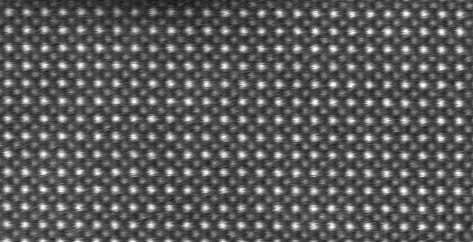
A crystallographic defect is an interruption of the regular patterns of arrangement of atoms or molecules in crystalline solids. The positions and orientations of particles, which are repeating at fixed distances determined by the unit cell parameters in crystals, exhibit a periodic crystal structure, but this is usually imperfect. Several types of defects are often characterized: point defects, line defects, planar defects, bulk defects. Topological homotopy establishes a mathematical method of characterization.
- field
- Crystallography, Materials Science
- known_for
- Classification of point, line, planar, and bulk defects in crystals
Lore & Background
Point defects occur only at or around a single lattice point and are not extended in space. They include vacancy defects, where a lattice site is vacant; interstitial defects, where an atom occupies a normally unoccupied site; and substitutional defects, where an impurity atom replaces a regular atom. A nearby pair of a vacancy and an interstitial is called a Frenkel defect. Antisite defects occur in ordered alloys when atoms of different types exchange positions. Topological defects are regions where the normal chemical bonding environment is topologically different from the surroundings, such as Stone Wales defects in nanotubes.
Reader's Guide
Line defects include dislocations, which are linear defects around which atoms are misaligned. Edge dislocations are caused by the termination of a plane of atoms, while screw dislocations involve a helical path traced around the defect. The presence of dislocations results in lattice strain expressed by a Burgers vector. Dislocations can move, leading to the characteristic malleability of metallic materials. Planar defects include grain boundaries, where crystallographic direction abruptly changes; antiphase boundaries in ordered alloys; stacking faults in close-packed structures; and twin boundaries, which introduce a plane of mirror symmetry. These defects influence mechanical, electrical, and optical properties of materials.
Did You Know?
- Vacancy defects are lattice sites that would be occupied in a perfect crystal but are vacant.
- A Frenkel defect is a nearby pair of a vacancy and an interstitial, caused when an ion moves into an interstitial site.
- Dislocations can be observed using transmission electron microscopy, field ion microscopy, and atom probe techniques.
- Antisite defects occur in ordered alloys when atoms of different type exchange positions.
More in Crystallography 1-20
Spotted an error? Know more?
This is a living reference — every entry is fact-audited, and reader corrections feed straight into our audit queue. Suggest an edit · See this site's audit record